SEO AI Search Visibility: How Small Sites Can Compete
Meta Description: Big brands dominate AI answers. Smaller sites can still win. Learn ways to improve AI search visibility with specific, helpful content.
URL Slug /ai-search-visibility-sites-vs-big-brands
AI Search Visibility: How Smaller Sites Can Compete With Big Brands
When I test queries in ChatGPT, Google AI Overviews, and Perplexity, the same names keep showing up. They are brands. If you run a site, that can feel discouraging.
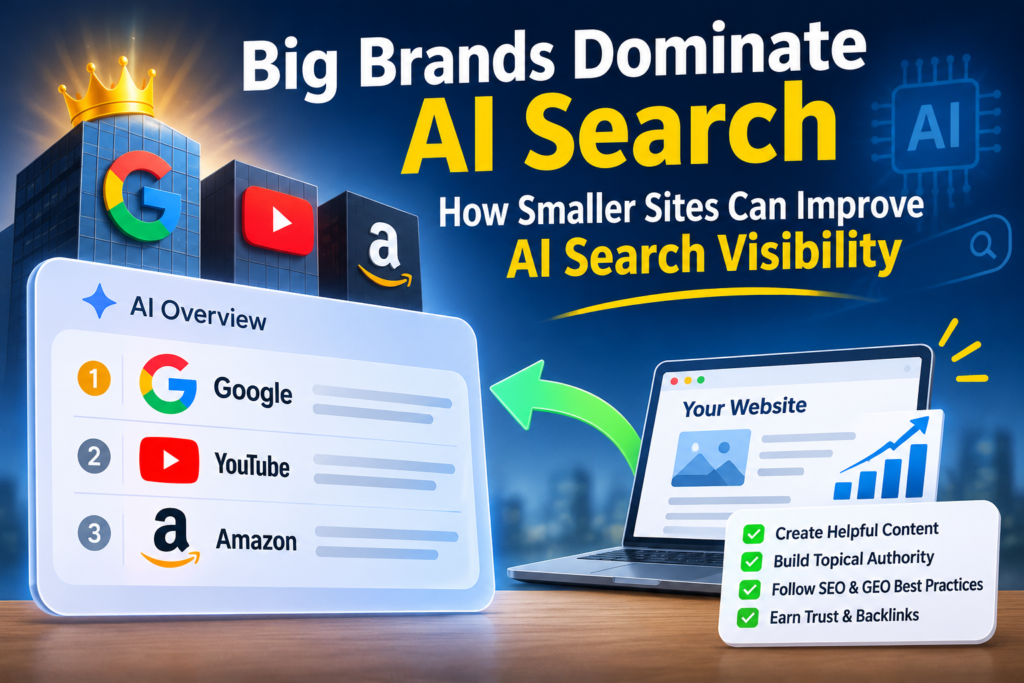
Low AI search visibility is not a life sentence. The playing field is tilted, not locked. In this post, I’ll explain why big brands win often, where the openings are, and what I’d do first if I were starting from scratch.
Why Big Brands Dominate AI Answers
AI tools lean on trust signals, and large brands have plenty of them. AI models are trained on datasets including user behavior, and people tend to click on familiar names, which influences which sites get cited.
Writesonic
There is also a loop at work: sites that rank at the top tend to collect AI citations, and those citations build more authority, which helps them hold their positions.
Writesonic
Recent research backs this up. BrightEdge found that top brands dominate travel categories in both ChatGPT and AI Overviews. American Airlines, for example, leads with 26 6% on Google AI Overviews and 25 3% on ChatGPT. That is one industry, so don’t assume every niche looks the same. Still, the pattern matches what I see when I test queries by hand.
Searchenginejournal
Where Smaller Sites Still Have an Opening
The research points to a gap. Big brands dominate less on queries, which opens the door for sites like Reddit and YouTube. The report also suggests that travel blogs and smaller sites with insight could benefit.
Searchenginejournal
Why does that matter? Queries that need experience are not what big brands usually write for. Some practitioners also argue that big brands write for audiences, while AI systems favor content that speaks directly to a real question. That is where a focused small site can shine.
Globerunner
Let me make it concrete: Search “best digital marketing tools for beginners,” and you will likely see established names like HubSpot and Semrush. A smaller site may publish a guide on the same topic and still get overlooked. Here is what I’d do about it.
Build a comparison of beginner-friendly tools.
Include examples, not just feature lists.
Add statistics and link to trusted sources.
Use proper schema markup.
Earn backlinks over time.
Those steps help a site build authority and improve its odds of being mentioned in AI answers.
A Simple AI Search Optimization Plan for This Week
You don’t need a budget to start AI search optimization. If I were advising a small site owner, I’d keep the week simple.
Pick one topic that is closely tied to your business.
List five questions your audience really asks about it.
Answer each question directly under a heading, ideally in the first two sentences.
Add examples and at least one reliable source per major claim.
Connect your pages with links and add relevant schema markup.
Then be patient. Visibility takes time, so consistency and quality matter more than speed.
What Big Brands Have vs What You Can Offer
Big brand advantage: Smaller site response
Brand recognition Clear niche focus
Large content teams: First-hand experience and real examples
Many backlinks relevant links
Broad topic coverage Direct answers to narrow questions
You can’t outspend a big brand. You can be specific, and specific content is easier for AI tools to use in an answer.
The Biggest Mistake Smaller Sites Make
The common mistake I see is chasing keywords and rankings instead of helping people. Many sites publish repetitive articles with no original insight no practical examples, and no reliable sources.
AI tools need trustworthy information to build an answer. If your page says what every other page says, there is no reason to cite it. Instead, answer questions directly, build authority one subject at a time, and write for the reader first.
How to Track Your AI Search Visibility
Tracking does not need software. Here is the simple process I’d use
Choose 10 to 20 target queries.
Test them in ChatGPT, Google AI Overviews, and Perplexity.
Note whether your site is mentioned or cited.
Compare the results with competitors.
Log everything in a spreadsheet. Repeat weekly.
A basic tracker could use these columns.
Query Platform Mentioned? Cited? Competitors shown Date
Over a week, patterns appear. You’ll see which pages earn mentions and which topics need work.
Limitations to Keep in Mind
I want to be honest: I have been applying these ideas on my site, ananthuks.com, including clearer headings, meta descriptions, improved structure, and early work on schema, internal linking, and GEO. I have not yet measured a confirmed improvement in AI search mentions
Also, AI answers change often. Results can differ by platform, location, and even by day. Treat any test as a snapshot, not proof. Industry matters too. What works for a travel blog may not work for a software review site.
FAQ
What is AI search visibility?
It is how often your site is mentioned or cited in AI-generated answers, such as those from ChatGPT, Perplexity, and Google AI Overviews.
Can small websites really compete with brands in AI search?
Yes, in cases where big brands lead on category-level queries. Narrow and experience-based questions leave real openings.
Is AI search optimization different from SEO?
They overlap. Good headings, content, trust signals, and structure still matter. AI search optimization adds a focus on answers and being easy to cite
Big brands do dominate AI answers today. That is only part of the story. Smaller sites can improve AI search visibility by being specific, helpful, and trustworthy, and by showing experience.
Start small. Pick one topic, answer five questions, and track the results weekly. Quality and consistency will beat shortcuts.